One Drone Per Person
Beginning on December 27 12:00am, all citizens may only own and operate a single drone at any one time. In the past year approximately 60% more drones have taken flight in our citystate. Clear skies are a shared resource that benefit everyone, and this resource is now feeling the pressure of over-utilization.
### How This Affects You
We understand you own five drones, one of which was recently ordered and has yet to be delivered. You are not being punished for owning or operating these.
#### Next Steps
Consolidate all drone duties. \[Consolidate\]
Cancel drone order. \[Cancel\]
Dispose of additional drones. \[Add to donation pool\] \[Return for credit\] \[Gift to someone\]
"The wording of this protocol change indicates they are only tracking active operating drones. We should keep one to disassemble and use for Project Luxembourg, if in the future the processors are harder to acquire." \[Keep 2nd Drone\]
### Personal Effect
*"Immediate: Errands and small deliveries are going to be harder to fulfill with this change, at our current utilization we'll only do about a third of our deliveries each day."
"After a while: If we build the right relationships, we may be able to set up temporary delivery drop-points and increase throughput. It is likely incentives are strong enough now for this plan to become realistic, though you have had trouble convincing the Patels before."
"Long run: Too difficult to project right now"*
## Rationale
Trigger: Shared Resource (Yellow Protocol)
The Independent Southeast SF Community Opportunity Zone is built on core principles of human flourishing and a celebration of a shared commons that is sustainable, useful, and beautiful. The rise in popularity of articulated wing bird drones has added beauty to our burgeoning citystate, evoking past times when birds were part of our natural world. That they also serve valuable functions like companionship, private communications, and delivery of small packages is a reason to celebrate the integral role they play in ISCO.
However, we also have a duty to maintain the commons, and the recent rise in the employment of these drones for commercial - rather than personal - purposes is now rapidly changing our environment. On any given day in ISCO, drones will fly by approximately once every 4 seconds. This is also projected to increase considerably in the next 6 to 12 months. These rapid changes triggered an automated analysis of the situation and potential mitigations, and simulations concluded (P < 0.012) that the best next step was to limit to one drone per person.
The commons is made up of many invisible resources that we take for granted until the moment they start to become scarce. We hope that by acting quickly, before the problem gets out of hand, we may find the right balance between the use of personal drones and the importance of clear skies and their positive effects on citizens.
## Alternatives Explored
Typically simulations come back with several alternative possibilities that would trigger legislative review, but in this case the second best option of sole proprietor exceptions was significantly worse (P <0.007) at maintaining clear skies and created another risk to the commons of loss of institutional trust, due to the perception of and potential for favoritism and algorithmic selection bias. As a result, these options were discarded without prejudice.
## Effects
Aside from clearer skies, the following are expected effects:
Heavy reduction of goods throughput via drone. We expect the throughput of goods delivered by drones to be reduced by 80% or more. Most uses of additional drones are commercial in nature, primarily in the delivery of small goods. These will instead travel via existing goods delivery services.
Mild reduction in one-one communications. Individuals that own one drone often use them for private communications. The major impact will be for the infrequent cases where there is trade off between the delivery of time-sensitive information and time-sensitive goods to different destinations. Sensitivity here is currently unknown. Drones are protected devices under the Sovereignty Compromise and thus any direct citystate intervention limiting their use has a change rating of 8, triggering a council process. Second order effect observations will thus be concentrated on these cases to ensure no meaningful loss of private freedoms.
Heavy reduction in one-many communications. In the last several months demand for drones has also risen due to new information distribution networks with similar topologies to the older one-to-many open networks prohibited in the Sovereignty Compromise. While the topologies themselves are not prohibited and the risk to interpersonal harmony remains theoretical, the creation of a de facto drone-delivered 'internet' could threaten the hard-fought balance of freedoms that the compromise protects. Direct action on the compromise has a change rating of 9 and triggers a council process, however going down this branch is unnecessary, as these network topologies require throughput that is only possible with a significant increase in drones per capita. This protocol change offers another means of limiting drones per capita, effectively nullifying the concern.
This puts a serious damper on Luxembourg. We should talk with the team.
## Protocol Cycle
As this is a non-essential resource limitation change, the standard 3-year experiment cycle applies. During this time, ongoing analysis will track first-order effects of drones per capita and utilization per drone, as well as second-order effects on commerce and social activity, as drones are primarily enablers of the former and substitutes for the latter. Standard emergency cancellation procedures apply.
At the end of the cycle, the effectiveness of the protocol change will be more thoroughly assessed for unexpected effects and counterfactuals, as well as any other cities who have not implemented changes of this nature. By default, this change will remain in effect with a change rating of 2 in the direction of loosening and 6 in the direction of tightening.
## Exceptions
No exceptions will be offered.
## Badge
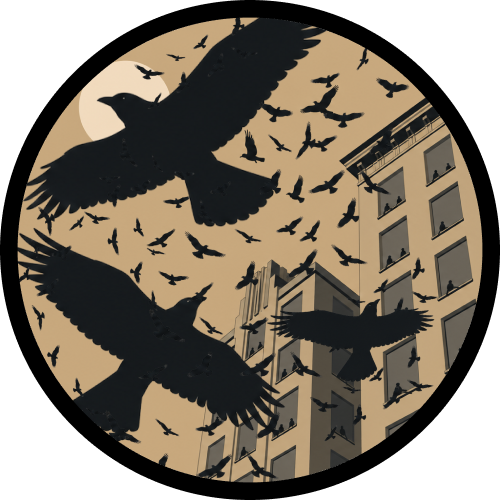
A badge has been minted for this protocol, depicting the over-use of the clear sky commons based on the projected increase in drones over the next 5 years at current rate. This badge will be awarded to all citizens who complete the protocol awareness curriculum.
I looked and I think you'll get through this in about an hour if you want to do it. Its probably a good idea for the optics to get one.